Mare Nostrum
Guardians of Gaia en mer
Mare Nostrum est l’expression marine de Guardians of Gaia, le programme mondial de Gaia First.
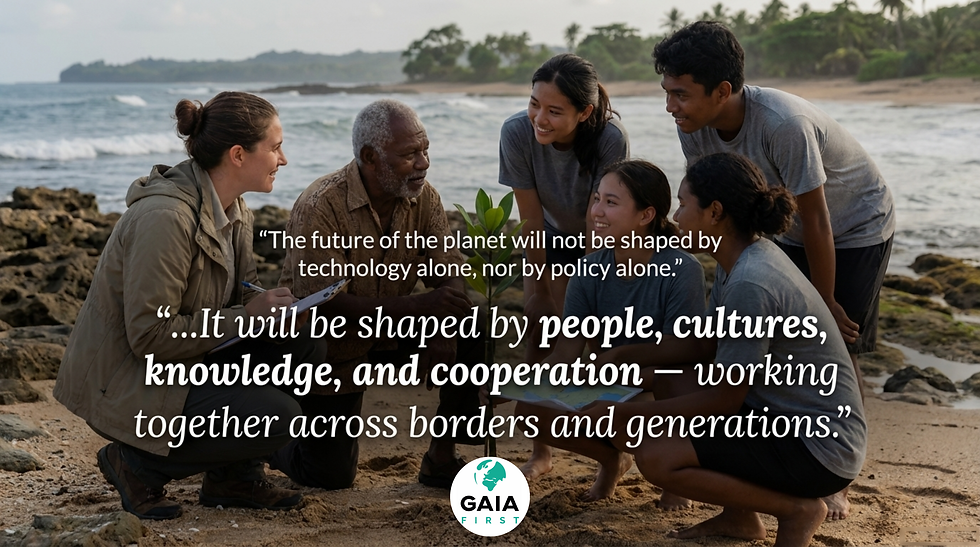
Il crée des pôles de conservation de long terme à travers les écosystèmes et transforme l’énergie de la jeunesse et la sagesse des communautés en intelligence collective au service de la planète.
Mare Nostrum se déploie à travers deux dimensions complémentaires:
-
un réseau de hubs côtiers vivants
-
des expéditions à la voile à bord d'un grand voilier placé sous le patronage de la Commission Nationale Française pour l'UNESCO.
Les volets marin et côtier du programme :
-
conduisent un suivi scientifique,
-
soutiennent les Aires Marines Protégées,
-
co-créent des récits de régénération le long des rivages.


Un réseau en pleine expansion
Grâce aux réseaux mondiaux de l’UNESCO — écoles, universités, chaires, institutions scientifiques et culturelles — Mare Nostrum contribue directement à la mise en œuvre de l’Agenda 2030 des Nations Unies et des Objectifs de développement durable, tout en ancrant l’action dans les territoires et les réalités locales.
Gaia First est partenaire stratégique :
-
du Partenariat IMO GloNoise,
-
du Programme IMO/FAO de Lutte contre les Déchets Marins, et
-
collabore avec le PNUE/PAM et le SPA/RAC dans le cadre de la Convention de Barcelone.
Un cadre intersectoriel pour l’action océanique
Ancré dans la philosophie de Guardians of Gaia, Mare Nostrum relie l'éducation, la science, la culture et la gouvernance pour activer une protection durable de l'océan.
Il traduit l'approche systémique du programme en actions maritimes concrètes, reliant écoles, universités, communautés côtières, ports et institutions en hubs de conservation vivants.
Plutôt que de se concentrer sur une seule dimension, Mare Nostrum opère à l'intersection de :
-
l'engagement des jeunes et de l'apprentissage tout au long de la vie,
-
le suivi scientifique et les savoirs et pratiques écologiques traditionnels,
-
l'action locale et la coopération internationale,
-
la protection de l'environnement et la responsabilité maritime.
C'est à travers Mare Nostrum que le volet marin de Guardians of Gaia est déployé, expérimenté et développé à plus grande échelle, de la Méditerranée aux autres bassins océaniques.


2027. L'expédition
Le Pelican of London sillonnera la Méditerranée entre les hubs de conservation, donnant vie à la science, à la culture et à la diplomatie en mer.
En raison de la situation géopolitique actuelle dans la région, l'expédition Mare Nostrum a été reportée à 2027.
Les candidatures sont désormais ouvertes aux étudiants, aux voyageurs en année de césure et aux jeunes explorateurs âgés de 18 ans et plus.

L'expédition est sous le patronage de la Commission nationale française pour l’UNESCO
La Commission nationale française pour l’UNESCO reconnaît la capacité du programme à relier science et culture, éducation et diplomatie, jeunesse et décideurs, au service de la coopération internationale et de la protection de l’environnement.


Comment une expédition de 6 semaines amplifie l'impact des hubs de conservation sur 3 ans
L’expédition n’est pas conçue pour « passer ».
Elle est conçue pour activer, former, relier, et laisser derrière elle une dynamique vivante, où la mer devient un sujet commun — et une responsabilité partagée.
Lorsque le navire quitte le port, le travail continue.
L’expédition comme catalyseur
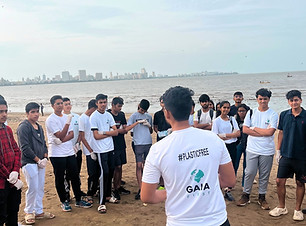
Lorsque le Pelican of London arrive, le temps s’accélère. L’expédition apporte visibilité, outils, protocoles et élan collectif.
Ateliers scientifiques, formations techniques, dialogues intergénérationnels, cérémonies culturelles, échanges politiques et actions de terrain se déploient en parallèle.
Puis le hub grandit.

Les hubs de conservation marine sur 3 ans
Chaque hub Mare Nostrum est un écosystème humain ancré dans un territoire : une école ou une université, une aire marine protégée ou un site côtier, une communauté, un port, une municipalité.
Sur trois ans, le hub devient un espace où les données sont collectées, les habitats restaurés, les jeunes formés, les savoirs traditionnels transmis et la gouvernance renforcée.