

Empower, Protect & Share
Nature does not function in sectors, and neither should solutions. For decades, environmental action has been divided into silos: land separated from sea, science disconnected from traditional knowledge, policy isolated from culture, waste treated as a technical issue rather than a systemic one. Gaia First exists to reconnect what has been artificially separated. We work across scales, from local territories to international institutions, to transform fragmented efforts into shared global intelligence and coherent, actionable strategies that serve both ecosystems and societies. Our Integrated Approach


About
Gaia First
Gaia First is an international NGO headquartered in Paris, with operational presence in Mumbai and Miami. We work at the intersection of environmental science, traditional knowledge, education, and global governance, designing and implementing programmes that treat the living world as what it is: one interconnected system.
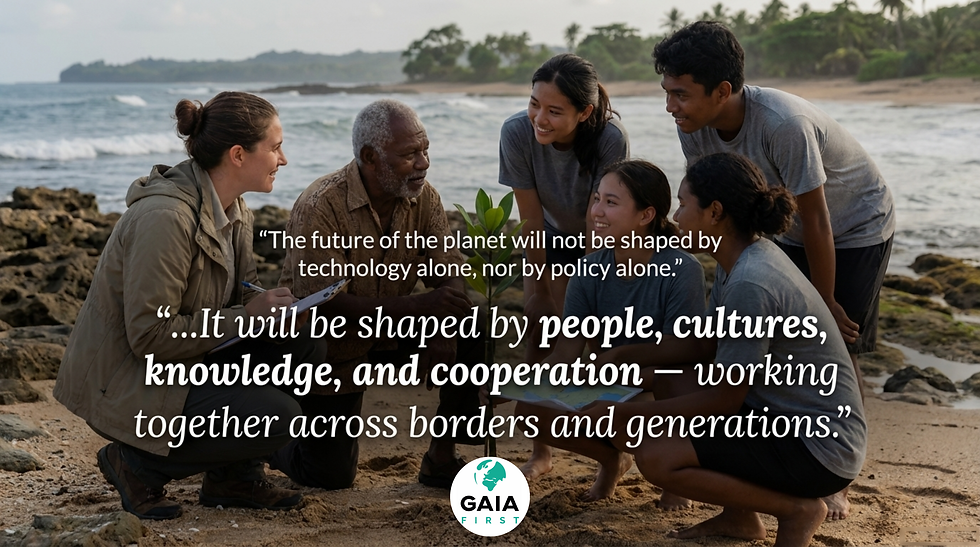
One conviction runs through everything we do: that lasting environmental action cannot be built in silos. It requires science and culture, local communities and international institutions, ancient knowledge and frontier research to work together, not in parallel, but as one. Today, this shapes the way our hubs are governed, the way our expeditions are designed, and the way we engage with the institutions and communities we work alongside.
Gaia First operates two complementary programmes: Guardians of Gaia / Mare Nostrum, a worldwide network of conservation hubs from mountains to the sea, and Advanced Molecular Recycling / The SHIELD, a systemic approach to plastic pollution interception centered on ports, communities, and people.
We are a recognised UN Ocean Decade Action, a strategic partner of the IMO and FAO, and operate under the patronage of the French National Commission for UNESCO.
![1[1]](https://static.wixstatic.com/media/794de5_b511a93f0d94432fb02e4b3668eb2763~mv2.png/v1/fill/w_980,h_547,al_c,q_90,usm_0.66_1.00_0.01,enc_avif,quality_auto/794de5_b511a93f0d94432fb02e4b3668eb2763~mv2.png)


Guardians of Gaia / Mare Nostrum has been officially endorsed as an Action of the UN Decade of Ocean Science for Sustainable Development (2021–2030)
Recognising its contribution to ocean knowledge, community stewardship, and the integration of Traditional Ecological Knowledge into conservation science.
For a general overview, you can watch this short video
(6 min)
ABOUT US
From mountains to oceans, restoring the vital functions of our living planet
Gaia First is an international environmental not-for-profit organization (NGO) working where everything connects:
- land and sea,
- nature and culture,
- local governance & global decision-making.
We design and implement holistic solutions that protect biodiversity, reduce pollution, and restore the Earth’s life-support systems, by bringing together science, technology, education, and cultural cooperation.
Recognized as a contributor to the United Nations Sustainable Development Goals, Gaia First builds a living system of collective intelligence and shared responsibility for a new era of planetary stewardship.

Global Frameworks & Recognitions
Gaia First’s work is embedded within the world’s most ambitious frameworks for global environmental governance
GLOBAL FRAMEWORKS
Agenda 2030 & the 30×30 Global Goal
Through a network of 150 regional stewardship hubs, Gaia First will contribute to the global objective of protecting 30% of land and ocean areas by 2030, in alignment with the UN Sustainable Development Goals.
BBNJ Agreement (High Seas Biodiversity Treaty)
Our initiatives directly support the implementation of the BBNJ Agreement, offering a scalable, community‑centered stewardship model for the protection of areas beyond national jurisdiction.
Article 8(j) of the CBD (Convention on Biological Diversity)
Gaia First’s programmes supports the respect, preservation, and maintenance of traditional knowledge, as well as the equitable sharing of benefits arising from its use. Our work with Mediterranean communities and coastal knowledge‑holders strengthens the transmission of Traditional Ecological Knowledge (TEK) and integrates it into marine conservation, stewardship, and educational initiatives.
Barcelona Convention & UNEP/MAP
Gaia First aligns with the UNEP Mediterranean Action Plan (MAP) to advance the Mediterranean Strategy for Sustainable Development 2026–2035, reinforcing regional cooperation for a healthier, more resilient Mediterranean Sea.
RECOGNITIONS
High Patronage of the French National Commission for UNESCO
The Mare Nostrum expedition is carried under the High Patronage of the French National Commission for UNESCO, acknowledging its unique capacity to bridge science, culture, and environmental diplomacy across the Mediterranean.
IMO/FAO Strategic Partner for the Ocean Litter Programme
Gaia First contributes to the OceanLitter Programme, supporting more than 30 countries in reducing marine plastic pollution from shipping and fisheries. This collaboration strengthens global efforts led by the International Maritime Organization (IMO) and the Food and Agriculture Organization (FAO).
UNESCO Green Citizen Recognition
Gaia First has been recognized as a UNESCO Green Citizen for its innovative sustainable solution and commitment to inclusive, community‑driven approaches to land and marine plastic mitigation.
Digital Sustainable Development Goals Programme (DSP) Support
Gaia First collaborates with the Digital SDG Programme (DSP), an international initiative endorsed by UNESCO and led by the International Research Center of Big Data for SDGs (CBAS). Through this partnership, Gaia First advances the SDGs by sharing marine data and helping develop digital tools for ocean stewardship and sustainable development.
A holistic approach


Nature does not function in sectors,
and neither should solutions.
For decades, environmental action has been divided into silos: land separated from sea, science disconnected from traditional knowledge, policy isolated from culture, waste treated as a technical issue rather than a systemic one.
Gaia First exists to reconnect what has been artificially separated. We work across scales, from local territories to international institutions, to transform fragmented efforts into shared global intelligence and coherent, actionable strategies that serve both ecosystems and societies.
To overcome fragmentation across all these domains, we are building a Federated Global Observatory that transforms local action into shared global intelligence. By connecting science, communities, and institutions into one living system, we enable integrated decision‑making that reflects the true interconnectedness of the natural world.

01
From Mountain to Sea
Environmental degradation does not start at the shoreline. We act across the entire water cycle — from mountains, rivers, and watersheds to coasts and the open sea — addressing challenges at their source rather than treating symptoms downstream. This integrated perspective replaces the traditional silo where land and ocean are managed as separate worlds.
03
Cultural Diplomacy & International Cooperation
Environmental governance often isolates technical action from cultural understanding and international dialogue. Through our expeditions and regional hubs, we bring nations, cultures, and generations together — fostering shared responsibility for the global commons and replacing fragmented diplomacy with collaborative stewardship.
02
Science & Traditional Ecological Knowledge (TEK)
Conservation has long been divided between scientific expertise and the lived knowledge of Indigenous and local communities. We bridge these worlds by combining cutting‑edge science (eDNA, underwater acoustics, marine data) with Traditional Ecological Knowledge when relevant. This synthesis creates solutions that are effective, ethical, and culturally grounded, moving beyond the siloed model where each knowledge system operates alone.
04
Breaking Silos: Building Circular Waste Systems
Waste systems are one of the clearest examples of fragmentation. Many existing treatment processes remain isolated, low‑tech, or resource‑intensive, often requiring significant water use to clean contaminated plastics for recycling. This siloed model — where prevention, collection, treatment, and valorization operate independently — limits efficiency and long‑term sustainability.
In contrast, an integrated, circular approach aligns technologies, data, and community engagement within a single framework. It reduces resource use, improves environmental outcomes, and creates scalable solutions that respond to both local realities and global sustainability goals.
Our 3 Pillars
Territorial Governance
Supporting local authorities and regional actors through a network of hubs that translate global frameworks into local action for conservation, education and depollution via waste management.
EMPOWER
Enabling People and Territories
We strengthen the capacity of communities, institutions, and leaders to act.
Education &
Youth Engagement
Intergenerational Transmission
Empowering the next generation through environmental education, scientific expeditions, and hands-on learning.
Connecting elders, knowledge holders, scientists, and young leaders to ensure continuity of wisdom and innovation.
The SHIELD — Ports as Protective Ecosystems
We intervene at the source of pollution by transforming waste streams into circular, low‑carbon systems — especially in coastal and maritime areas where impacts are most severe and port reception facilities urgently need reinforcement.
The SHIELD — Ports as Protective Ecoystems
At the heart of this approach lies the SHIELD (Systemic Hub for Integrated Environmental & Logistics Defense) to reimagine ports and coastal infrastructures not as pressure points, but as active guardians of the ocean.
Through the SHIELD, ports become:
-
Interception points, stopping waste and pollution before it reaches the sea
-
Circular energy hubs, transforming non-recyclable waste into clean energy and strategic materials
-
Data and compliance platforms, supporting environmental reporting, transparency, and international standard
-
A social model, transforming port facilities into resilience hubs that provide dignity, opportunity, and inclusion — especially for women — by converting waste into economic, energy, and educational resources for local communities.
By integrating Waste-to-Energy, traceability, and environmental monitoring, the SHIELD strengthens:
-
ocean and coastal protection,
-
port resilience and energy autonomy,
-
compliance with IMO, EU, and UN environmental frameworks.
PROTECT
Safeguarding Life, Ecosystems & Critical Infrastructure
We protect the living world by acting where environmental degradation actually occurs — at the interface between nature, cities, and infrastructure. Protection today means more than conservation alone. It requires redesigning systems so that pollution is prevented, ecosystems can recover, and essential infrastructures become part of the solution.
Ecosystems & Biodiversity
We protect and restore terrestrial and marine ecosystems through science-based conservation, field expeditions, and long-term monitoring — from watersheds to open seas.
Cultural & Maritime Heritage
Protection also means safeguarding living heritage.
We work with maritime communities and Indigenous knowledge holders to preserve traditional practices that embody sustainable relationships with land and sea.
Digital Earth Twin
Working with universities, UN agencies, port authorities, and governments to enable coordinated, evidence-based action.
Waste as a Systemic Challenge — and a Systemic Solution
Within this holistic mission, waste management is not a technical detail — it is a planetary issue. Poorly managed waste undermines:
-
biodiversity and ocean health,
-
public health and social equity,
-
port resilience and maritime governance.
Gaia First addresses waste not as an isolated problem, but as part of a broader transformation toward circular, low-carbon, and transparent systems — aligned with international maritime, environmental, and climate frameworks.
This is why our work naturally engages port authorities, IMO-related stakeholders, cities, and governments, alongside educators, scientists, and conservation actors.
SHARE
Connecting Knowledge and Action
We believe that planetary stewardship requires shared data, shared responsibility, and shared governance.
Open Data & Open Science
Making environmental data accessible to scholars, researchers, institutions, and policymakers.
Our Governance
At Gaia First, leadership is built on complementarity, shared vision, and co‑creation. Gianni Valenti, Johanna Auguin, and Captain Rahul Damodaran form a cohesive governance team that bridges technology, education, and maritime expertise. Their collaboration anchors Gaia First’s mission across land and sea—integrating regenerative infrastructure, cultural and scientific transmission, and operational excellence. Together, they guide SHIELD, Guardians of Gaia, and Mare Nostrum as interconnected pillars of a global movement for planetary regeneration, ensuring that innovation, equity, and environmental stewardship advance hand in hand.

President & Founder
Gianni Valenti is the President and Founder of Gaia First, and an international leader in biodiversity protection, environmental innovation, and the advancement of rights‑of‑nature frameworks.
He is the originator of the Ocean Waste‑to‑Energy initiative, transforming plastic pollution into clean, renewable energy through zero‑emissions systems.
Through his co‑leadership with Johanna Auguin, his technological vision expands into SHIELD, a holistic framework integrating waste interception, energy production, data traceability, and port infrastructure with governance, education, and community resilience. His work aligns with IMO and MARPOL standards while advancing scalable, real‑world solutions for ocean protection and circular economies. Gianni is internationally recognised through UNESCO Green Citizens, TEDx, and contributions to major global ocean and sustainability forums.

Director
Johanna Auguin is the Director of Gaia First and co-founder of the Gaia First India Foundation. She leads global strategies in education, equity, and cultural diplomacy. She is the founder of Guardians of Gaia, a UNESCO‑supported programme that blends Indigenous and traditional ecological knowledge with scientific research, experiential learning, and youth leadership.
Under her co‑leadership with Gianni Valenti, Guardians of Gaia evolves into a global framework aligned with the 2030 Agenda, envisioning 150 local conservation hubs across more than 60 countries, supported by open science and the Earth Twin collaborative platform. Together, they also lead Mare Nostrum—the maritime counterpart and floating think tank connecting youth, researchers, Indigenous leaders, and institutions through hands‑on conservation. Johanna’s work places equity, intergenerational transmission, and inclusion at the heart of environmental action.

Co-Director
Captain Rahul Damodaran is Co‑Director of Gaia First and co-founder of the Gaia First India Foundation. He brings two decades of maritime law, ocean governance, and operational expertise. A licensed Master Mariner and graduate of the IMO’s International Maritime Law Institute, he is an Associate Fellow of the Nautical Institute (UK) and a Lifetime Fellow of The Company of Master Mariners of India. His experience spans IMO/FAO regulatory alignment, compliant depollution technologies, maritime training systems, and climate‑resilient risk management. His career includes international roles with Mitsui OSK Lines in Tokyo and Singapore, academic distinctions such as the President’s Gold Medal, and recognition for innovative storm‑prediction modelling. Within Gaia First’s shared leadership, Rahul strengthens maritime strategy, supporting port‑reception solutions, vessel‑compliance frameworks, and training modules essential to SHIELD and Mare Nostrum, ensuring that field operations remain safe, compliant, and grounded in the highest environmental and legal standards.