
_edited_ed.png)
.png)
The Mare Nostrum Blueprint
Launching 150 Conservation Hubs in 60 Countries
Mare Nostrum is not only an expedition at sea.
It is the marine deployment arm of Guardians of Gaia — the space where the program’s global vision takes shape along coastlines, ports, islands and marine protected areas.
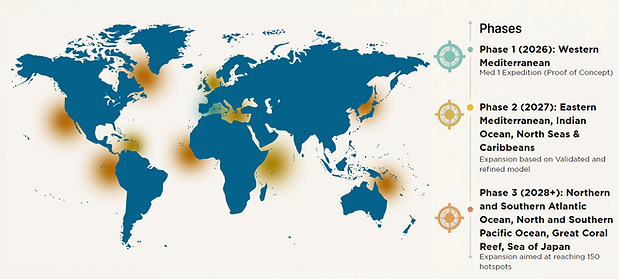

How a 6‑week expedition ignites 3‑year conservation hubs
The expedition is not designed to “pass through.”
It is designed to activate, train, connect, and leave behind a living dynamic place where the sea becomes a a shared subject — and a shared responsibility.
When the ship departs, the work continues.
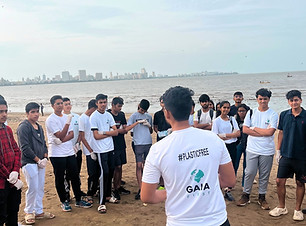
The Expedition as a Catalyst
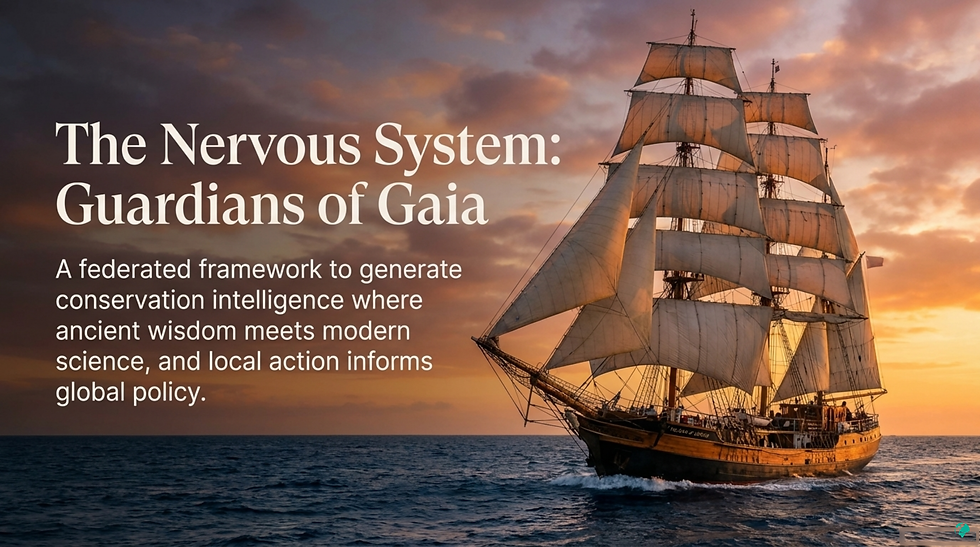
When the Pelican of London arrives, time accelerates. The expedition brings visibility, tools, protocols, and momentum.
Scientific workshops, technical trainings, intergenerational dialogues, cultural ceremonies, policy conversations, and field actions unfold in parallel.
The hub takes over — and grows.

The 3‑Year Marine Conservation Hubs
Each Mare Nostrum hub is a human ecosystem rooted in a place: a school or university, a marine protected area or coastal site, a community, a port, a municipality.
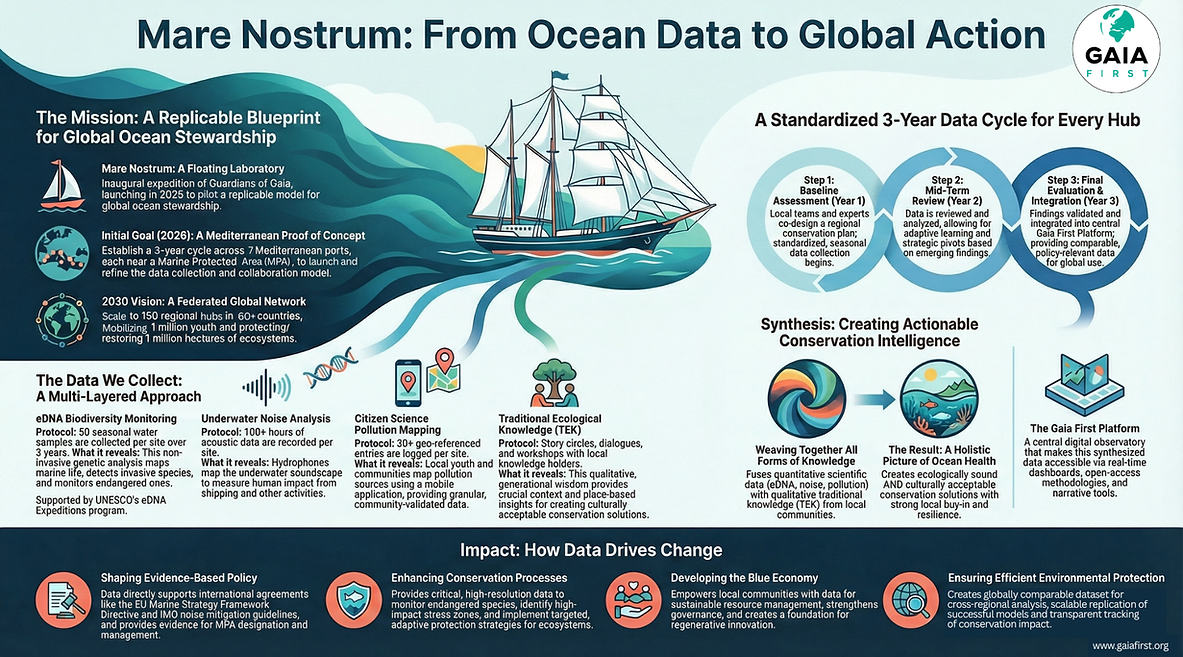
Over three years, the hub becomes a space where data is collected, habitats are restored, young people are trained, traditional knowledge is transmitted, and governance is strengthened.

Aligned with the UN
2030 Agenda
By 2030, Gaia First aims to achieve:
-
150 regional conservation hubs activated in over 60 countries,
-
1 million hectares of ecosystems protected or restored,
-
1 million young people engaged in planetary stewardship,
-
150+ policy briefs supporting global conservation governance.
Mare Nostrum contributes directly to these objectives by anchoring them in coastal and marine territories, where ecological, economic and cultural pressures converge.
A Plateform of Collective Intelligence at Sea
Each coastal hub of Guardians of Gaia operates as a living node of Open Science and collective intelligence, contributing directly to the Gaia First Digital Earth Twin and the UNESCO-endorsed Digital Sustainable Development Goals (DSP) framework.
Through standardized field protocols deployed during expeditions such as Mare Nostrum and sustained by local institutions, hubs generate high-quality, comparable environmental data — from biodiversity (eDNA) and underwater noise to pollution and restoration indicators — while integrating Traditional Ecological Knowledge under prior informed consent.
This convergence of local action, open data, and ethical knowledge sharing transforms coastal territories into long-term observatories that feed global sustainability datasets, support evidence-based decision-making, and strengthen planetary governance — turning the ocean into a shared space of learning, stewardship, and science for the future of the planet.
