Mare Nostrum
Guardians of Gaia at Sea
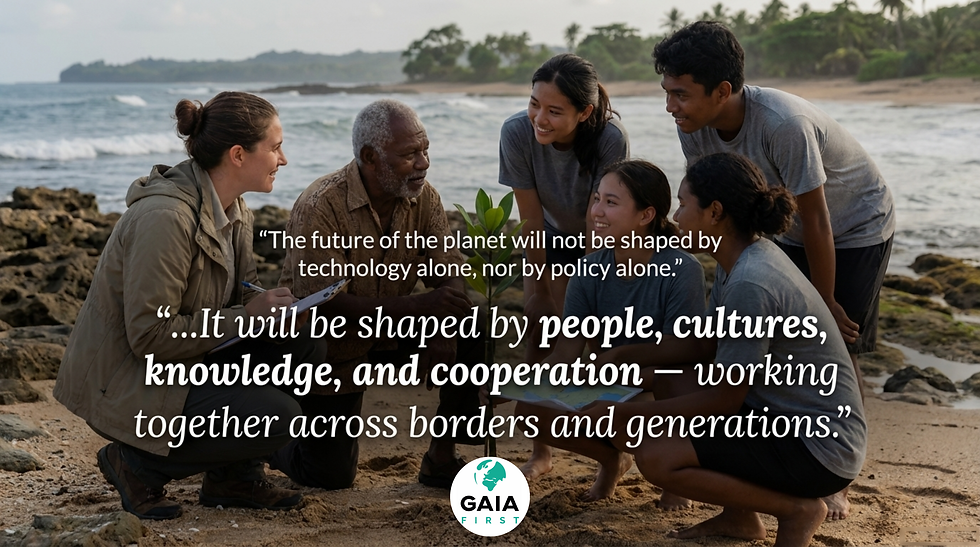
Mare Nostrum is the marine expression of Guardians of Gaia, the Gaia First global program that creates long-term conservation hubs across ecosystems and transforms youth energy and community wisdom into collective intelligence for the planet.
Mare Nostrum unfolds through two complementary dimensions :
-
a network of coastal living hubs
-
Sailing expeditions aboard a tall ship placed under the patronage of the French National Commission for UNESCO.
The marine and coastal pillars of the program :
-
conduct scientific monitoring,
-
support Marine Protected Areas,
-
co-create stories of regeneration across the shores.


A Growing Network
Through UNESCO’s global networks of schools, universities, chairs, science and cultural institutions, Mare Nostrum contributes directly to the United Nation Agenda 2030 and Sustainable Development Goals, while grounding action in lived territories.
Gaia First is a strategic partner of :
-
the IMO GloNoise Partnerships,
-
the IMO/FAO Ocean Litter Programme, and
-
collaborates with UNEP/MAP and SPA/RAC within the framework of the Barcelona Convention.
A Cross‑Sector Framework for Ocean Action
Rooted in the Guardians of Gaia philosophy, Mare Nostrum connects education, science, culture and governance to activate long-term stewardship of the ocean.
It translates the program’s systemic approach into concrete maritime action, linking schools, universities, coastal communities, ports and institutions into living conservation hubs.
Rather than focusing on a single dimension, Mare Nostrum operates at the intersection of:
-
youth engagement and lifelong learning,
-
scientific monitoring and traditional ecological knowledge,
-
local action and international cooperation,
-
environmental protection and maritime responsibility.
It is through Mare Nostrum that the marine component of Guardians of Gaia is deployed, tested and scaled, from the Mediterranean to other ocean basins.


2027. The Expedition
The Pelican of London will sail between Mediterranean conservation hubs, bringing science, culture, and diplomacy to life at sea.
Due to the current geopolitical situation in the region, the Mare Nostrum expedition has been rescheduled to 2027.
Applications are now open for students, gap year travellers, and young explorers aged 18 and over.


How a 6‑week expedition amplifies 3‑year conservation hubs
The expedition is not designed to “pass through.”
It is designed to activate, train, connect, and leave behind a living dynamic place where the sea becomes a a shared subject — and a shared responsibility.
When the ship departs, the work continues.
The Expedition as a Catalyst
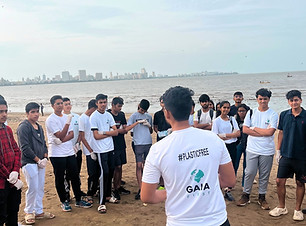
When the Pelican of London arrives, time accelerates. The expedition brings visibility, tools, protocols, and momentum.
Scientific workshops, technical trainings, intergenerational dialogues, cultural ceremonies, policy conversations, and field actions unfold in parallel.
The hub grows.

The 3‑Year Marine Conservation Hubs
Each Mare Nostrum hub is a human ecosystem rooted in a place: a school or university, a marine protected area or coastal site, a community, a port, a municipality.
Over three years, the hub becomes a space where data is collected, habitats are restored, young people are trained, traditional knowledge is transmitted, and governance is strengthened.