
Guardians of Gaia / Mare Nostrum
A UN Ocean Decade Action · Supported by UNESCO

« This ambitious project aims to bridge the gap between traditional knowledge and ecological science, creating a holistic approach to environmental education through local school initiatives. Its primary objective is to empower students and local communities to recognize, value, and actively help preserve traditional ecological knowledge. This aligns with UNESCO's mission to safeguard, transmit, and promote traditional knowledge through education and conservation. »
Unesco Letter, 10 February 2025.
Division of Ecological and Earth Sciences and
Man and the Biosphere Programme (MAB) Natural Sciences Sector


The Programme
Guardians of Gaia is an international programme built on a single conviction: that protecting the living world requires bringing together every form of knowledge we have, scientific and traditional, global and local, ancient and emerging.
It creates a worldwide network of conservation hubs, from mountains to the sea, where science, Traditional Ecological Knowledge, education, and community governance work together as an integrated whole. Each hub is locally rooted and globally connected, generating comparable data while honouring the unique character of the territory it inhabits.
The goal is the progressive deployment of 150 hubs across 60+ countries by 2030, contributing directly to the objectives of the UN Decade of Ocean Science for Sustainable Development.
It speaks to two complementary forces : A generation that learns, and a generation that transmits.


A Holistic Approach
“Learn to see with one eye through the strengths of Indigenous knowledge,
and with the other through the strengths of Western science —
and use both together for the benefit of all.”
The “Two-Eyed Seeing”,
taught by Mi’kmaq Elder Albert Marshall:
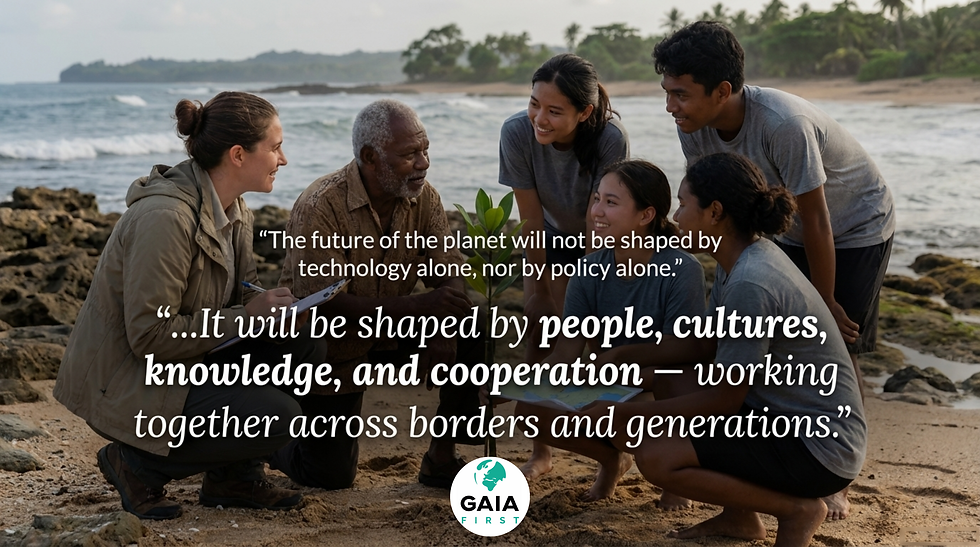
Guardians of Gaia places Traditional Knowledge holders and Indigenous Peoples at the heart of conservation, as co-educators and co-designers of solutions.
-
Traditional Ecological Knowledge provides relational ethics, long-term local observation, and a deep understanding of living systems built across generations.
-
Science provides global tools: biodiversity monitoring, data analysis, satellite observation.
This is not a philosophical position. It is an operational one, reflected in the design of every hub, every protocol, and every tool in the network.
The Earth is one interconnected system, and protecting it requires acting across ecosystems, cultures, and generations.
The program creates a global network of regional hubs dedicated to:
-
restoring ecosystems,
-
transmitting knowledge,
-
empowering youth,
-
and generating shared environmental intelligence.

Mountains to Sea:
A Systemic Approach
By linking watersheds, rivers, coasts, and oceans, the program ensures that actions taken upstream protect ecosystems downstream.
This approach addresses one of the greatest limits of conservation today: fragmented data that cannot inform global decision-making.
The hubs will generate comparable, high-quality data, feeding global open-data systems while strengthening local engagement and governance.
Every hub in the network, every protocol, and every partnership in the Guardians of Gaia network, whether anchored in a forest, a highland, a river delta, or a coastal bay, will be guided by this the holistic principle.

Mare Nostrum
Guardians of Gaia at Sea
The marine and coastal pillar of the program. What changes at the coast is the medium, the protocols, and the institutional landscape. What does not change is the foundation.
Mare Nostrum is not a separate marine programme that happens to share a name. It is Guardians of Gaia at sea, carrying with it the same spirit, the same commitments.
Guardians of Gaia operates through two interconnected branches, united by the same framework, the same values, and the same holistic approach.
→ Terrestrial & Freshwater Hubs
Forests, mountains, rivers, wetlands, and inland ecosystems.
→ Mare Nostrum HUBS — Coastal & Ocean Branch

A Global Network of Guardians
Creating a global network of young guardians through conservaiton hubs and/or in-school or extra-curricular educational activities. Students, alongside local communities, will be able to understand and then adopt an active role in the protection of local ecosystems and cultural heritage.
The hubs become meeting places where the preservation of nature and cultures intertwine, reinforcing the idea that protecting the environment also means protecting the identity and knowledge of a people.
Approach: implementation of school and/or extra-curricular activities enriched with traditional and indigenous knowledge.
-
Cultural transmission : Indigenous communities can share ecological and cultural knowledge, demonstrating that traditional environmental practices are inseparable from the protection of their cultural heritage.
-
Practical immersion : Students can explore local ecosystems and, when possible, designate a natural area to be protected and become its guardians while respecting indigenous knowledge.
-
Global network : Interconnected sanctuaries around the world create an intercultural learning community, where students exchange environmental and cultural methods, solutions and knowledge, creating deep connections for a sustainable and inclusive future.